EU MRV · Technical reference
EU MRV for shipping: scope, annual cycle and verification
How EU MRV works for ships: who must monitor, the yearly cycle from monitoring plan to verified report, the 31 March deadline and what gets filed in THETIS-MRV.
EU MRV — monitoring, reporting and verification — is the regulation that makes every other European maritime climate rule computable. It does not price emissions, rate ships or set a fuel standard; it establishes the verified, voyage-level emissions record that the EU ETS surrender obligation is calculated from, and that FuelEU Maritime and the IMO CII draw on in their own ways. Regulation (EU) 2015/757 created it Reg (EU) 2015/757 ; the 2023 revision, Regulation (EU) 2023/957, aligned it with the ETS by adding gases and ship types and by moving the reporting deadline earlier Reg (EU) 2023/957 . Because MRV is a process rather than a calculation, this page is organised around the process: who is covered, the yearly cycle from monitoring plan to document of compliance, and what a company actually files.
What MRV is, and why it exists
The regulation exists so that the emissions figure behind every downstream obligation is measured under an approved plan and checked by someone with no stake in the result. A company writes down, in advance, how each ship will monitor fuel, distance, time at sea and cargo; an accredited verifier assesses that plan; the ship monitors every voyage against it for a calendar year; the company aggregates the year into an emissions report; the verifier checks the report; and the verified figure is submitted to the Commission and the flag State. Since the 2023 revision that verified figure is also the input to the EU ETS — the ETS Directive does not collect emissions data of its own Dir. 2003/87/EC · Art. 3ga .
Who and what is covered
MRV applies to ships of 5,000 gross tonnage and above, of any flag, for voyages that arrive at, depart from or take place between ports under the jurisdiction of an EU Member State, and for the time spent at berth in those ports Reg (EU) 2015/757 . Warships, naval auxiliaries, fish-catching and fish-processing ships, wooden ships of primitive build, ships not propelled by mechanical means and government ships used for non-commercial purposes are exempt. The 2023 revision widened both axes Reg (EU) 2023/957 : from the 2024 reporting year, methane and nitrous oxide are monitored alongside carbon dioxide; and from the 2025 reporting year, general cargo ships between 400 and 5,000 gross tonnage and offshore ships of 400 gross tonnage and above are brought into monitoring and reporting, ahead of any decision on their inclusion in the trading system.
One distinction matters for everything that follows. MRV monitors and reports the whole emissions of every in-scope voyage — the Singapore-to-Rotterdam leg is recorded in full. The half and full voyage shares belong to the EU ETS Dir. 2003/87/EC · Art. 3ga , which applies them to the MRV figures when it calculates the surrender obligation. MRV is the measurement layer; the ETS is the pricing layer that reads from it.
The annual cycle
The cycle runs on the calendar year, with the paperwork of one year overlapping the monitoring of the next. Each step has its own articles in the regulation.
Step 1 — the monitoring plan
Before a ship's first voyage in scope, the company submits a monitoring plan for that ship to a verifier Reg (EU) 2015/757 · Arts 6–10 . The plan describes the ship, the emission sources on board, the method chosen for fuel consumption (bunker delivery notes with tank soundings, tank monitoring, flow meters or direct emission measurement), the fuel-to-emission factors, and how distance, time at sea and cargo carried will be recorded. The verifier assesses the plan for conformity with the regulation Reg (EU) 2015/757 · Arts 13–16 ; a plan found to be non-conforming cannot be used, and material changes to ship or method require the plan to be updated and reassessed. Plans are drafted and submitted in the electronic template held in THETIS-MRV Impl. Reg (EU) 2023/2449 .
Step 2 — per-voyage monitoring
For every in-scope voyage the ship records the fuel consumed by fuel type, the emissions derived from it, the distance travelled, the time spent at sea and the cargo carried, using the method fixed in its plan Reg (EU) 2015/757 · Arts 6–10 . Time at berth in EEA ports is monitored as well. Voyage boundaries follow the ports of call, which is why the quality of port-call and bunker records decides the quality of the whole year.
Step 3 — annual aggregation
At the end of the calendar year the per-voyage records are aggregated into totals for the ship: emissions, fuel by type, distance, time at sea, cargo and the resulting transport-work efficiency figures Reg (EU) 2015/757 · Arts 6–10 . This aggregated set is the emissions report's substance; it is also the data the EU ETS surrender calculation and, for the company as a whole, the ETS company-level report are built on.
Step 4 — independent verification
An accredited verifier checks the emissions report against the monitoring plan and the regulation: completeness, consistency of the data flows, application of the plan's methods and factors, and the plausibility of the totals Reg (EU) 2015/757 · Arts 13–16 . Verifiers are accredited under the EU accreditation framework and must be independent of the company; a verifier that assessed the plan may verify the report, but the company may not verify itself. Only a report the verifier considers satisfactory can proceed.
Step 5 — submission by 31 March
From the 2024 reporting year onwards, the verified emissions report for each ship is submitted to the Commission and to the flag State by 31 March of the following year Reg (EU) 2015/757 · Arts 11–11a , through THETIS-MRV. A company with ships in the EU ETS also submits, by the same date, an aggregated company-level report of the emissions the ETS will price Reg (EU) 2015/757 · Arts 11–11a . The earlier deadline is what gives the ETS time to work: allowances for the previous year's verified emissions must be surrendered by 30 September Dir. 2003/87/EC · Art. 12 .
Step 6 — the document of compliance
When the report is satisfactory, the verifier issues a document of compliance for the ship Reg (EU) 2015/757 · Arts 17–19 . By 30 June of the year following the reporting period the document must be carried on board, and port-State inspections in EEA ports check that it is there. It is the physical evidence that the cycle closed.
What gets filed
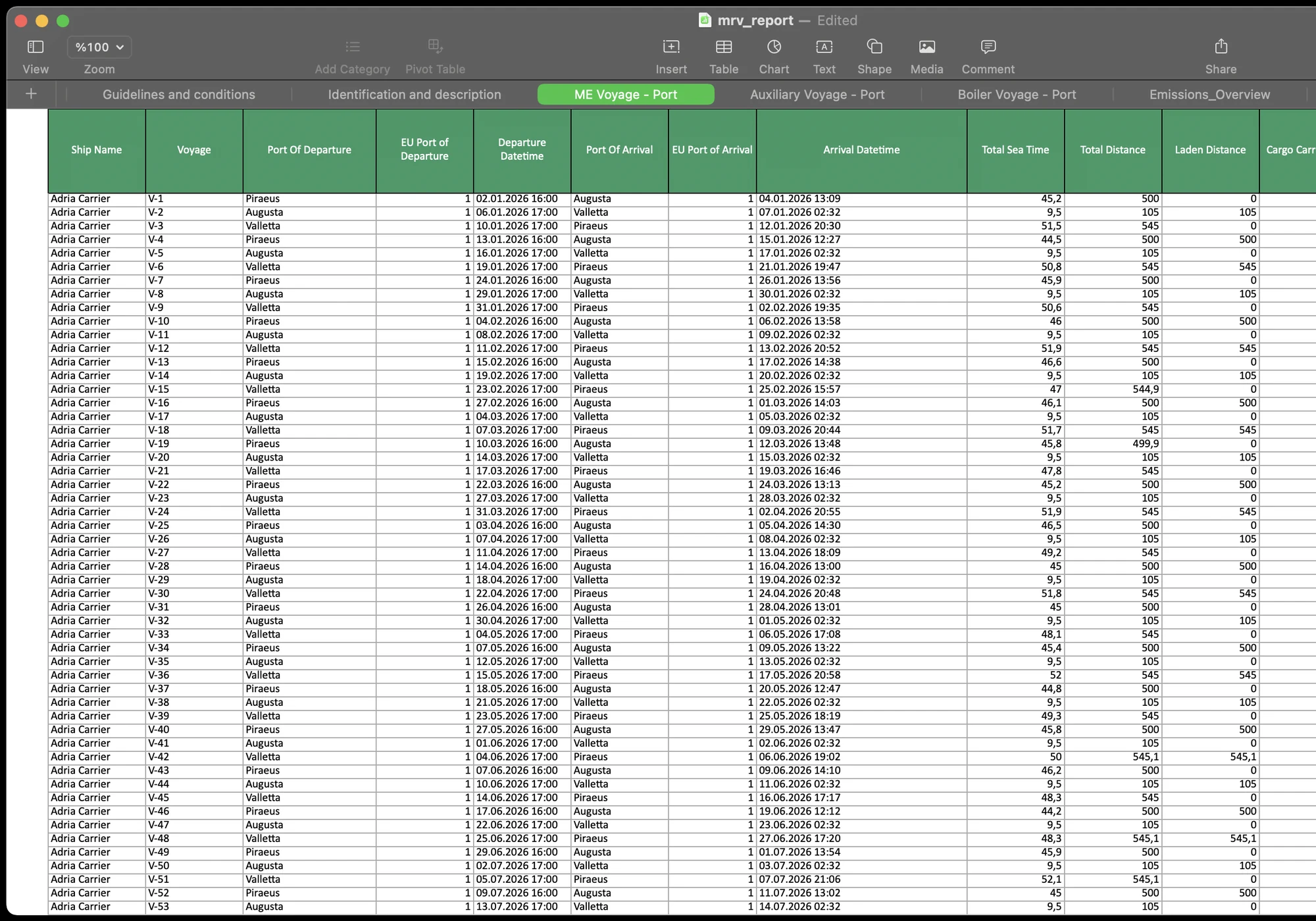
Two artefacts leave the company each year, both in the templates of Commission Implementing Regulation (EU) 2023/2449 Impl. Reg (EU) 2023/2449 : the verified emissions report itself, and its electronic submission in THETIS-MRV. In practice the report is prepared as a structured workbook the verifier can audit line by line, and then submitted in the system's own format. Carbonlogy produces both from the same voyage ledger — the MRV emissions report as an Excel workbook for the verifier, and the THETIS-MRV XML for submission — so the numbers the verifier signs and the numbers the system receives are the same numbers.
Last reviewed · Carbonlogy Compliance Team
How Carbonlogy applies it
Carbonlogy treats the voyage ledger as the single record that MRV, the ETS, FuelEU and CII all read. Each voyage carries its ports of call, its MRV scope, its bunker consumption by fuel type and its distance and time; validation flags gaps before they reach a verifier. At year end the platform generates the per-ship emissions report as an Excel workbook and the THETIS-MRV XML from that ledger, and the ETS, FuelEU and CII figures shown elsewhere in the product are computed from the same voyages, so a correction made once is reflected everywhere.
Frequently asked questions
- What is EU MRV and how is it different from the EU ETS?
EU MRV is the measurement layer and the EU ETS is the pricing layer. Regulation (EU) 2015/757 requires ships calling at EEA ports to monitor their emissions per voyage, report them yearly and have the report verified by an accredited verifier; the EU ETS then takes those verified figures, applies its own voyage shares and phase-in, and requires allowances to be surrendered for the result. A ship can be in MRV without being in the ETS, but never the reverse.
- Who verifies the MRV emissions report?
An independent verifier accredited under Regulation (EU) 2015/757 — not the flag State, the port State or the company itself. The verifier first assesses the ship's monitoring plan and then checks the yearly emissions report against it; only a report the verifier finds satisfactory can be submitted and can earn a document of compliance.
Reg (EU) 2015/757 · Arts 13–16 Reg (EU) 2015/757 · Arts 17–19
- What is THETIS-MRV?
THETIS-MRV is the Union information system, operated by the European Maritime Safety Agency, through which companies submit monitoring plans and verified emissions reports and verifiers issue documents of compliance. The templates it uses are laid down in Commission Implementing Regulation (EU) 2023/2449, which replaced the original 2016 templates.
- When is the EU MRV emissions report due?
By 31 March of the year following the reporting period, from the 2024 reporting year onwards. The per-ship report, verified as satisfactory, goes to the Commission and the flag State through THETIS-MRV, and companies with ships in the EU ETS file an aggregated company-level report by the same date; the document of compliance must then be on board by 30 June.
Reg (EU) 2015/757 · Arts 11–11a Reg (EU) 2015/757 · Arts 17–19
Sources cited
- [1]Regulation (EU) 2015/757 (EU MRV)EUR-Lex
- [2]Regulation (EU) 2023/957 — amending Regulation (EU) 2015/757 (EU MRV) for the ETSEUR-Lex
- [3]Regulation (EU) 2015/757 (EU MRV), as amended by Regulation (EU) 2023/957 — Articles 6–10 — monitoring plan (assessed by the verifier, submitted via THETIS-MRV), per-voyage and annual monitoringEUR-Lex
- [4]Regulation (EU) 2015/757 (EU MRV), as amended by Regulation (EU) 2023/957 — Articles 11–11a — verified emissions report per ship, and the company-level report for ETS ships, by 31 March each year from 2025EUR-Lex
- [5]Regulation (EU) 2015/757 (EU MRV), as amended by Regulation (EU) 2023/957 — Articles 13–16 — verification of the monitoring plan and the emissions report by an independent accredited verifierEUR-Lex
- [6]Regulation (EU) 2015/757 (EU MRV), as amended by Regulation (EU) 2023/957 — Articles 17–19 — document of compliance issued by the verifier, carried on board by 30 June of the following year, checked at port-State inspectionEUR-Lex
- [7]Commission Implementing Regulation (EU) 2023/2449 — templates for monitoring plans, emissions reports, partial emissions reports, documents of compliance and company-level reports (electronic versions in THETIS-MRV); repeals Implementing Regulation (EU) 2016/1927EUR-Lex
- [8]Directive 2003/87/EC (EU ETS), as amended by Directive (EU) 2023/959 — Article 3ga — scope of application to maritime transport (voyage shares: 100 % intra-EEA and at berth, 50 % to/from third countries)EUR-Lex
- [9]Directive 2003/87/EC (EU ETS), as amended by Directive (EU) 2023/959 — Article 12(3) — surrender of allowances for the previous year's verified maritime emissions by 30 SeptemberEUR-Lex
- [10]IMO Resolution MEPC.328(76) — 2021 revised MARPOL Annex VI — Regulations 27 (fuel oil consumption data collection — IMO DCS) and 28 (attained and required annual operational CII; rating; corrective action plan)IMO · Official text · URL pending
All citations checked automatically · updated 2026-10-21